Pierre Le Forestier
Few formats have lasted as long as 120 film. More than a century after its invention, it still feeds the medium format cameras of today's film photography lovers. Its story begins with a small cardboard box sold for one dollar, and continues, surprisingly, all the way to a 1980s Japanese camera whose very name pays tribute to those origins.
To understand 120, you have to go back to the late 19th century. George Eastman, aiming at the general public, produced the first flexible photographic film for a simple camera, the Kodak « 100 exposures ». After working in insurance and banking, Eastman turned to making dry plates, then in 1888 launched the first camera under the Kodak brand, a name he had invented from scratch.
This flexible film would be improved at the turn of the century so that it could be loaded in daylight: a decisive step in making photography accessible to all.
© Photo credit: Photo of George Eastman | United States Library of Congress
In February 1900, Eastman Kodak launched the Brownie, designed by engineer Frank A. Brownell. The Brownie was a simple cardboard box with a meniscus lens and a curved film plane to compensate for the lens's flaws. Its name paid tribute to the fairy-like characters made popular by Canadian writer Palmer Cox, and the camera was originally aimed at... children.
Its success went far beyond Kodak's hopes. Thanks to its very simple controls and its initial price of one dollar, combined with the low cost of Kodak film and processing, the Brownie far exceeded its sales target. More than 150,000 were sold in the first year of production.
But this first Brownie used a film format that no longer exists, 117. Everything changed the following year.
© Photo credit: Rathfelder, Kodak Brownie advert, via Wikimedia Commons
120 film was invented by Kodak in 1901 and launched with a camera called the Kodak Brownie No. 2. The Brownie No. 2 was made by Eastman Kodak from 1901 to 1935, in five models from A to F, and was the first camera to use 120 film. It produced square 6 x 6 cm images: a format that would span the entire 20th century and, much later, inspire cameras such as the Bronica SQ and the Hasselblad 500.
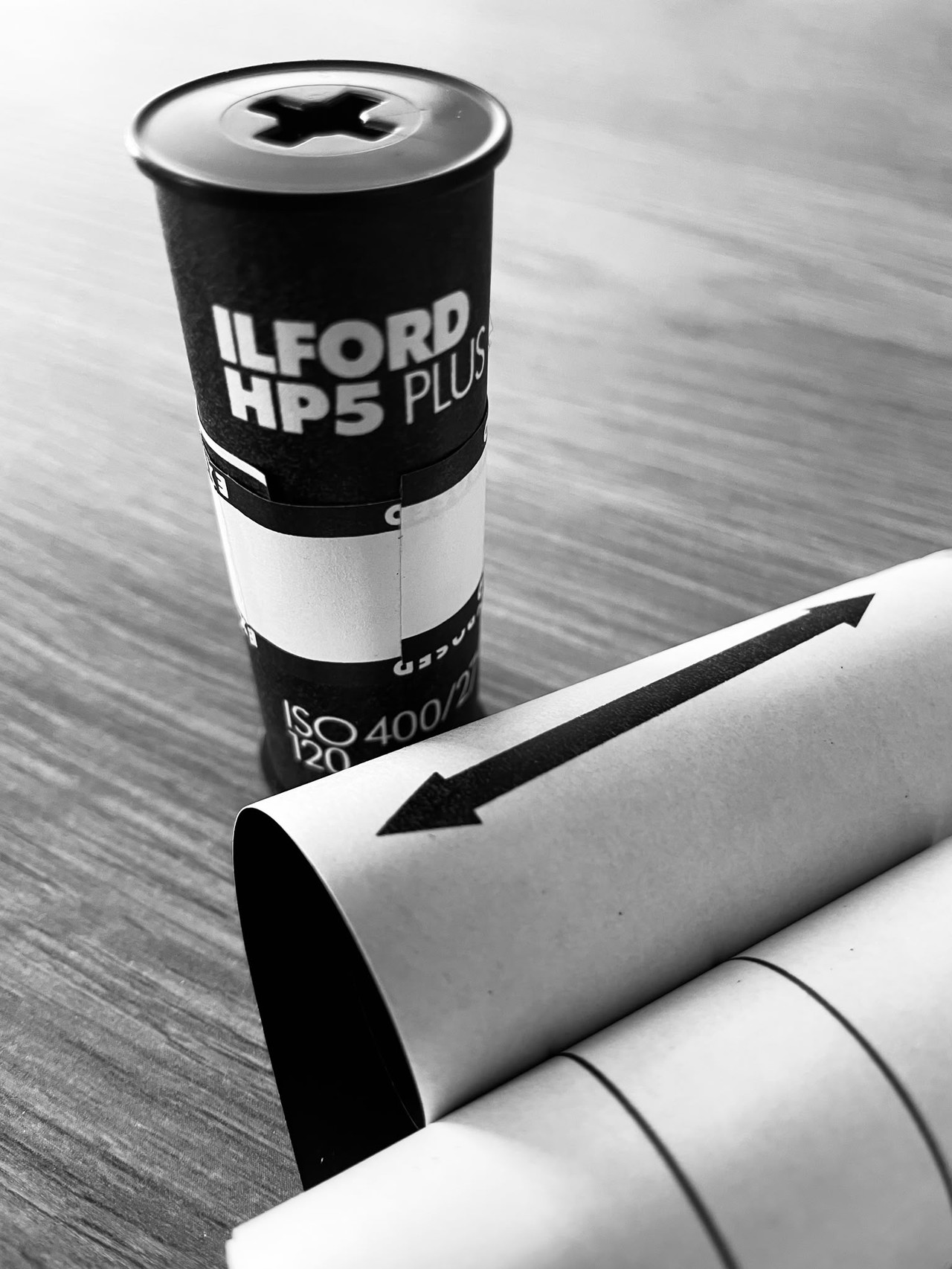
The principle of 120 film is simple but clever: a flexible film wound on a spool and protected from light by opaque paper, so it can be loaded and unloaded in daylight without a darkroom: a decisive selling point for the general public of the time.
© Photo credit: Gerry Lauzon, Kodak Brownie No. 2 F, via Wikimedia Commons
The Brownie No. 2 enjoyed huge success and rare longevity: it lived through both world wars, photographed historic scenes (Bernice Palmer's photos aboard the Carpathia the day after the Titanic sank, or pictures of the Russian imperial family), and stayed in production for more than thirty years.
The Brownie's success rested on clear economic logic: sell the camera cheaply to generate recurring income from film and processing. Eastman summed up this approach in a famous slogan:
« You press the button, we do the rest »
So the Brownie is not just a technical object: it is the cornerstone of a business model that would make Kodak's fortune for a century.
The 120 format did not stand still. In 1931 Kodak launched the 620 format, a variant of 120 using the same 6 cm film width but a thinner spool, to make more compact cameras: a commercial move designed to keep customers within the Kodak ecosystem. The 220 format, a double-length version, appeared in 1965, doubling the number of exposures on a roll.
But it is the original 120 that outlived every trend: while the 135 format (the famous « 35mm » borrowed from cinema and popularised by Leica in the 1920s) dominated amateur photography, 120 became the standard for professional medium format, prized for the quality of its much larger negatives.
The story takes an unexpected turn in Japan. The Bronica brand, founded by Zenzaburō Yoshino, launched its first medium format camera in 1959. The name Bronica comes from « buroni », a distortion of the Japanese pronunciation of Kodak Brownie: a direct nod to the camera that, sixty years earlier, had invented the very format Bronica would use. The film format was indeed the same as the Kodak Brownie's.
Twenty years later, in 1980, Bronica launched the series that would cement its reputation with professionals: the Bronica SQ.
© Photo credits: Arnaud Elissalde and Sophie Compain
The Bronica SQ is a 6x6 medium format SLR that replaced the Bronica EC as the square-format camera from August 1980. Designed in Japan as a cheaper yet equally high-quality alternative to the imposing Hasselblad 500, the SQ takes its name from the English word « square », after its 6x6 cm image format, which produces twelve frames on a standard roll of 120 film.
Technically, the Bronica SQ is a modular camera inspired by the Hasselblad 500. It accepts 120 and 220 film and even Polaroid backs, and sits at the centre of a large professional system with its own mount. Its optical system relies on an electronic leaf shutter made by Seiko, built into each lens, with speeds from 8 seconds to 1/500th of a second, allowing flash sync at every speed: a decisive advantage for studio and wedding photographers.
The Bronica SQ's success came from smart positioning: for under 1,250 dollars at launch, a fraction of the cost of a Hasselblad 500C/M, professionals had access to interchangeable film backs, lenses and viewfinders with no compromise on image quality. Bronica offered around 95% of a Hasselblad's features for 60% of the price, winning over a generation of freelance photographers working in makeshift studios.
The SQ system grew throughout the 1980s and 1990s:
In 1995, lens maker Tamron bought Bronica's camera business, before the brand gradually faded with the rise of digital: on 1 October 2004, Tamron announced the worldwide end of production of Bronica SLRs and accessories, ending more than forty years of adventure in film medium format.
There is something striking about this lineage: a one-dollar cardboard camera, designed to bring photography to American families at the start of the 20th century, left behind a film format that decades later would equip Japan's most sophisticated professional cameras. So much so that one of those manufacturers chose to carry the phonetic memory of the little Brownie in its own name. Today, 120 film is still made and used by photographers who load their rolls exactly as people did in 1901: in daylight, with no complication at all.
We keep this love of film alive within the collective. Discover the work of Simon Arcache, who shoots black and white film, at Crossed Perspectives #1, Sound and Vision (31 July - 2 August, Hendaye, free entry).
Exhibitions, events, calls for projects and blog articles: get the key news from the Argia Collective straight to your inbox.
Grain, chemistry, light: dive deeper into film photography.
Cookies
We and selected third parties use cookies or similar technologies for technical purposes and, with your consent, for experience, measurement and marketing.