Arnaud Elissalde
Every year on 19 August, photography is celebrated all over the world. This date is no accident. It takes us back to Paris in 1839, to a moment when a still mysterious invention was about to be revealed to the public and permanently change the way we look at the world.
To understand why 19 August became World Photography Day, we need to go back to that special day when the secret of the daguerreotype was officially unveiled.
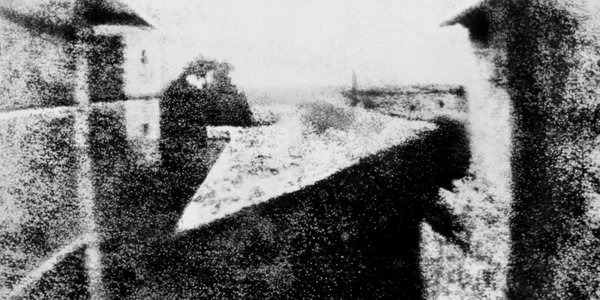
Photography already existed. Since the 1820s, Nicéphore Niépce had been trying to fix the images produced by light and had made the first surviving photographic images. But his process remained complex and still hard to use. His meeting with Louis Daguerre would give his research a new dimension.
Nicéphore Niépce, View from the Window at Le Gras (around 1826-1827): the oldest surviving photograph. Public domain.
When Niépce and Daguerre began working together in 1829, they shared the same dream: to permanently fix the images that light forms in front of the lens.
Their research was different but complementary. Niépce had already managed to obtain images through heliography. Daguerre, an artist and showman, had long been interested in the effects of light and was also trying to reproduce reality with ever greater precision.
After Niépce's death in 1833, Daguerre continued the research alone. His experiments led to a process that was faster and, above all, much more precise than Niépce's early methods.
He named it the daguerreotype.
The principle was revolutionary. A copper plate coated with a thin layer of silver was made sensitive to light. After exposure and chemical treatment, an extremely detailed image appeared on its surface. For the first time, it became possible to represent the world with a precision beyond anything traditional reproduction techniques had allowed until then.
But Daguerre had not yet revealed his invention to the general public.
Louis Daguerre, Boulevard du Temple (1838): one of the first daguerreotypes, the first photograph to show a human being. Public domain.
The moment came in Paris on 19 August 1839.
A few months earlier, the French government had decided to buy the rights to Daguerre's process so that it would be free for anyone to use. The invention would therefore not be reserved for Daguerre or a privileged few: anyone could use it.
That day, François Arago officially presented the process to the Academy of Sciences and the Academy of Fine Arts. The technical details of the daguerreotype were revealed and Daguerre's invention became public.
François Arago presents the daguerreotype to the Academy of Sciences, 19 August 1839. Public domain.
The scene matters because it marks much more than a simple scientific presentation.
For the first time, the world could see in practice that it was possible to fix an image produced directly by light.
Photography then left the workshops and experiments and entered public life.
That is why 19 August holds a special place in the history of photography.
The news spread quickly.
The daguerreotype impressed with the fineness of its images. The details visible on a plate were astonishingly precise for the time. The first demonstrations aroused the curiosity of scientists, artists, writers and the general public.
Very quickly, photographers began experimenting with the process in cities across Europe and America.
The first portraits appeared. Monuments were photographed. City views became subjects. Families wanted to keep images of their loved ones.
Photography thus began to move from experiment to practice. It would gradually transform our relationship with portraiture, landscape and memory.
Before photography, keeping a person's likeness required the work of a painter, draughtsman or engraver. A portrait was an interpretation made by an artist's hand and was usually reserved for those who could afford it.
Photography profoundly changed this relationship with images. From then on, it became possible to keep someone's face with unprecedented precision. The photographic portrait would soon take on a huge place in families.
But something deeper was also at stake. Photography makes it possible to hold on to a moment. It gives form to something that, by nature, disappears.
Perhaps that is why, almost two centuries later, we still take photographs with such intensity.
Today, taking a photo has become almost instinctive. We have a camera in our phone and can keep an image in a fraction of a second.
Yet our gesture is not so different from that of the first photographers.
We take photographs because a moment catches our attention and we want to hold on to it. We know the light will change, the landscape won't be quite the same, the people around us will change and some moments won't come back.
A photograph lets us keep a trace. It doesn't really keep the moment. It can't record what we heard, felt or thought. But it can bring all of that back when we look at it years later.
That explains the power of old photographs. An imperfect image can become precious simply because it is linked to a story we don't want to lose.
Photography soon went beyond the private sphere, however.
As techniques improved, it became a tool for documenting the world. Photographers began showing cities, monuments, landscapes and the changes of their time. Photography gradually made its way into newspapers, books, scientific institutions and artistic practice.
It became a way of bearing witness.
A photograph can keep a trace of a place that no longer exists. It can show an event to those who didn't live through it. It can make a distant reality visible and become part of our collective memory.
But it is always the result of a point of view. The photographer chooses where to stand, what to show and what to leave out of the frame. Even when it claims to document reality, a photograph is always an interpretation of it.
This question has become even more important today, when images can be retouched, transformed and generated by artificial intelligence.
It is fascinating to see how far we have come since 19 August 1839.
The daguerreotype required time, chemicals and careful preparation. The image was unique and fixed directly onto a metal plate.
Today, a photograph can be taken instantly, stored by the thousand and shared around the world in seconds.
Photography has become so simple and so present that it sometimes seems to have lost the exceptional character it had in the early days of the daguerreotype. Yet our relationship with images still rests on the same desire:
We now produce more images than ever. But this abundance raises a new question: what becomes of all these photographs?
Some disappear into a phone's memory. Others are shared and then forgotten. Only a few will really stand the test of time.
In the end, this is quite close to what happened in the early days of photography. In every era, technology allows us to produce more images, but their true value often only becomes clear later.
A photograph can seem insignificant when it is taken and become essential years later.
We don't always know which images will become our memories.
So 19 August is not just a date chosen to pay tribute to photography. It commemorates the day an invention was revealed to the public and made available to the world.
When they presented the daguerreotype in 1839, Daguerre and Arago obviously had no idea what photography would become. They could not have imagined film cameras, colour photography, digital, the smartphone or images generated by artificial intelligence.
Yet they opened a door that has never stopped widening.
Photography has become a universal language. It lets us tell our lives, document our times and pass on our memory.
As the bicentenary of photography approaches, 19 August is a fine opportunity to look back on how far we have come.
Everything around photography has changed, but its essential gesture remains surprisingly simple.
Someone looks.
Something catches their attention.
So they decide to keep that image.
Perhaps this is what links Niépce's first photographic gaze to the millions of images made today. Techniques have changed, cameras have become almost invisible and images are now everywhere. But the desire remains. To stop a moment. To keep it. And one day, to be able to look at it again.
Perhaps that is what we really celebrate every 19 August.
Photography is not just the story of an invention. It is the story of a way of seeing that we have learned to keep.
Because on 19 August 1839, in Paris, François Arago officially presented the daguerreotype process to the Academy of Sciences and the Academy of Fine Arts. The French government had bought the rights to make it free to use: photography became accessible to all.
Nicéphore Niépce made the first surviving photographic images in the 1820s, using heliography. Louis Daguerre, who worked with him from 1829, developed a faster and more precise process after Niépce's death (1833): the daguerreotype.
It was the first photographic process released to the public. A copper plate coated with a thin layer of silver is made sensitive to light; after exposure and chemical treatment, a highly detailed image appears on its surface.
On 19 August 1839, with the official unveiling of the daguerreotype. Photography then left the workshops and experiments and entered public life.
Exhibitions, events, calls for projects and blog articles: get the key news from the Argia Collective straight to your inbox.
The photographic gaze, from yesterday to the 2027 anniversary year.
Cookies
We and selected third parties use cookies or similar technologies for technical purposes and, with your consent, for experience, measurement and marketing.