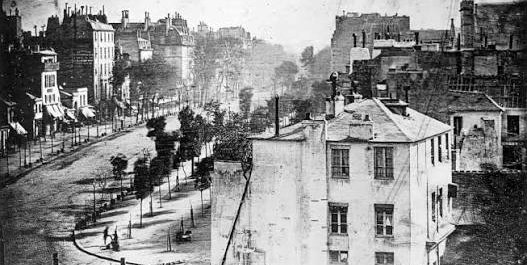
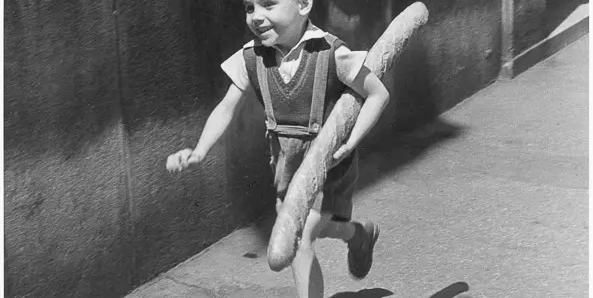
From September 2026 to September 2027, photography will officially celebrate its 200th birthday. This historic anniversary will bring, in France and internationally, many exhibitions, encounters and events devoted to a form of expression that has profoundly changed the way we see the world.

In 1827, in a house in Burgundy at Saint-Loup-de-Varennes, a man waits for hours in front of a still fragile invention. From his workshop window, Nicéphore Niépce is attempting something that seems almost impossible: to capture light permanently.
On a pewter plate coated with bitumen of Judea, the sun slowly imprints the outline of a roof, a courtyard and a few sunlit buildings. The exposure time is enormous. Nothing guarantees the experiment will work. For years, Niépce had been looking for a way to capture reality without having to draw it by hand.
The result is strange. A grey, blurry, almost unreadable image. And yet it is the first known photograph in history: View from the Window at Le Gras.
Two centuries later, we photograph our lives every day, often without thinking. A meal, a landscape, a loved one's face, a detail glimpsed in the street. Billions of images circulate around the world every day.
But it all starts here: with this imperfect image born from a Burgundy window and an inventor's stubborn patience.
Nicéphore Niépce was neither a famous artist nor a powerful industrialist. He was a curious and stubborn inventor from Burgundy, fascinated by a simple yet dizzying idea: how can you permanently preserve an image produced by light?
For years he experimented in the shadows. Chemistry, engraving, optics: he tested, failed and started again. The name he gave his process already tells its whole poetry: heliography, literally "writing with the sun".
In 1827, from the window of his house at Saint-Loup-de-Varennes, he produced View from the Window at Le Gras, now considered the first photograph in history.
The fate of this image also has something of a novel about it. Lost for decades, it was only rediscovered in 1952. It is now kept at the University of Texas at Austin, far from the landscape where it all began.
Niépce himself never knew the scale of his discovery. He died in 1833, long before photography transformed the whole world. He never saw the family portraits, the reportage, the archives, the artworks or the billions of images that would come after him.
Below you will find a portrait of Niépce and the plans of his house, where it all began.
People talk about the bicentenary of photography in 2027, but the celebrations will start on 1 September 2026 and run until 30 September 2027.
This major national event is led by the French Ministry of Culture, with the aim of celebrating the invention of photography, its heritage and its contemporary vitality.
The announced highlights include a major manifesto exhibition at the Grand Palais in autumn 2026, in partnership with the Centre Pompidou, and a historical exhibition devoted to Nicéphore Niépce at the Musée Nicéphore Niépce in Chalon-sur-Saône.
But the spirit of this celebration goes far beyond the major national institutions. Festivals, collectives, schools, artists, independent venues and associations are invited to take up this anniversary all over France, and beyond.
Because celebrating 200 years of photography is not just about looking back. It is also about asking why photographs matter and what they say today about our societies, our regions and our lives.
Since Niépce's heliography, photography has never stopped changing form.
The daguerreotype made portraits accessible. Film accompanied family albums, newspapers, wars and travels. Digital transformed our relationship with time and with how images are shared. Then the smartphone turned every one of us into an everyday photographer.
With each change, the same questions come back.
What is a photograph? Proof? A memory? A work of art? Who has the right to make images? Who do they belong to? What do they really show of the world?
Today, with the arrival of images generated by artificial intelligence, these questions keep shifting and renewing themselves.
And yet something has remained deeply intact since 1827: the human desire to leave a trace.
Photography is not just a technique. It is a way of inhabiting the world, of telling a presence, of creating bonds between people and generations.
Taking a photograph is often trying to hold on to what is disappearing: a particular light, a face, a landscape, an emotion, a shared moment. It is saying "I was there", or sometimes simply "look at what I saw".
Exhibitions, events, calls for projects and blog articles: get the key news from the Argia Collective straight to your inbox.
Two hundred years after its beginnings, photography has become a universal language.
Photography crosses borders, cultures and generations; it documents the upheavals of the world, accompanies our lives, bears witness, denounces, records, celebrates, preserves memories and brings people together.
A photograph can be a work of art in a museum, a historical archive, a press document, a family memory or an image shared in seconds with the other side of the world.
Rarely has an artistic practice so transformed our relationship with reality.
We look at the world through images. We remember events through photographs. We sometimes build our identities, our collective stories and our shared memory from them.
That is also why this bicentenary goes far beyond a simple historical commemoration. It raises a deeply contemporary question: what do we still want to show, pass on and look at together?
The Three Crowns Festival will take place in Hendaye in spring 2027 and will celebrate the bicentenary of photography through international, national and local contemporary perspectives. The story that began two centuries ago is still being written.
The festival fully embraces the spirit of this national movement: bringing photography as close as possible to places and people by creating moments of exchange between photographers and audiences.
Photography comes alive when it is shown, when it sparks encounters, dialogue, questions and/or shared emotion. The Three Crowns Festival and the Argia Collective's activities aim to show that contemporary photography is a living practice in constant motion.
It is in this spirit that Basque photographer Arnaud Elissalde began his Artzainak series: years of fieldwork with Basque shepherds to photograph a changing world, with the patience and rigour that characterised the great humanists of the last century.
Two hundred years after Nicéphore Niépce's first image, photography keeps changing the way we look at the world and tell our lives, our memories and our bonds.
The 2027 bicentenary does not just celebrate a technical invention. This commemorative period will be a chance to remember how much photography, from its very beginnings, has accompanied the social, cultural and political changes in our societies.
In spring 2027, the Three Crowns Festival will take part in this collective story with a programme devoted to contemporary perspectives. And also through the Crossed Perspectives 2026 series, which from this summer explores photography as a dialogue between disciplines, cultures and generations.
The Hendaye photography festival and the 2027 year of photography.
Join the Argia photography collective
Cookies
We and selected third parties use cookies or similar technologies for technical purposes and, with your consent, for experience, measurement and marketing.