At the end of the article, you'll find a printable Memo sheet: film printing: the essentials for going from negative to print without forgetting anything.

Pierre Le Forestier
Behind the scenes in the darkroom, where a blank sheet becomes an image.
There is something almost ritual about the gesture. A blank sheet of paper, dipped into a developer bath under a dim red light, and suddenly, as if from nowhere, an image appears. This moment, which photographers call the « reveal », remains one of the most fascinating in all of photography. While digital has made the image instant and disposable, film printing is enjoying an unexpected revival, driven by a generation looking for slowness and texture.
In the 2000s, many predicted the darkroom would disappear altogether. Kodak stopped making some historic papers, professional labs closed one after another, and film seemed destined for the same fate as cinema film in the face of digital. Twenty years later, the picture is very different: Ilford still produces high-end fibre-based papers, new independent manufacturers are emerging, and community printing workshops are fully booked in Paris, Berlin and New York.
This comeback is no accident. It responds to a weariness with the endless scroll of digital images. A film print is unique: literally impossible to reproduce identically, dependent on a gesture, a bath temperature, a way of agitating. That element of chance, which digital has tried so hard to eliminate, has become the process's added value.
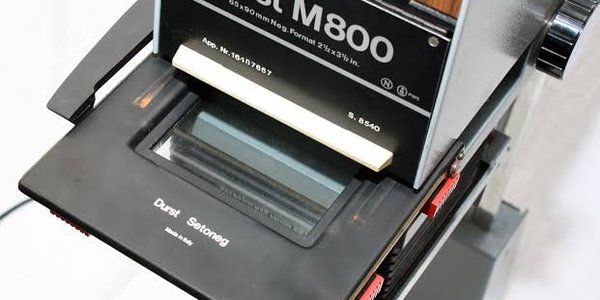
Technically, film printing rests on a simple principle: photographic paper is coated with an emulsion of light-sensitive silver salts. When a negative is projected onto this paper with an enlarger, the areas exposed to light undergo an invisible chemical change: the latent image. The developer bath makes it visible by reducing the exposed silver salts to metallic silver, which is literally black.
Next comes the stop bath, which halts the reaction instantly, then the fixer, which dissolves the silver salts that did not react to light, making the image stable and insensitive to any further light. A long rinse removes chemical residues, without which the print would yellow over time. Each step has its own timing, temperature and tolerance for error, and it is precisely in this demand that the whole art of the craft lies.
While exposure determines the overall density of a print, it is contrast that shapes its character. So-called « multigrade » papers, now the norm, let you adjust contrast with coloured filters, from grade 0 (very soft) to grade 5 (very hard), without changing paper. A flat, lifeless negative will gain intensity with a high filter; conversely, an overly contrasty negative can be softened.
But beyond technique, the choice of contrast is an aesthetic decision. Some printers, like the legendary Ansel Adams with his « zone system », raised this mastery to an almost scientific discipline, precisely mapping the relationship between a scene's exposure and its rendering in shades of grey. Others prefer a more intuitive approach, guided by the eye and experience built up at the developing tray.
Few people outside the field know the practice of « dodge and burn » (selective masking and extra exposure), yet it is essential to an accomplished print. While the negative is being projected, the printer physically intervenes in the light beam: darkening an area that is too light by exposing it longer (« burn »), or shielding an area that is too dark with their hands or a cut-out mask to lighten it (« dodge »). Repeated print after print, this gesture gradually refines the image's balance: the work of a light sculptor, which can take hours for a single photograph destined for an exhibition.
An argument often put forward by purists: longevity. A properly fixed and washed fibre-based print can last more than a century without noticeable deterioration, as vintage prints in museum collections show. RC (resin-coated) paper, quicker to dry and cheaper, is still preferred for everyday use, but collectors and museums continue to insist on fibre-based paper for its tonal richness and stability over time.
Once the print is fixed and washed, some photographers choose to tone it: an extra bath that chemically alters the metallic silver particles to change their colour, tone or, above all, their stability over time. Far from being just an aesthetic effect, toning is also a conservation technique.
The most widespread among demanding printers: very dilute, it deepens the blacks and adds a slight, almost imperceptible cool cast; at stronger dilutions, it shifts towards purple-brown. Beyond aesthetics, it makes the image much more resistant to atmospheric damage, a strong argument for prints meant for archiving or exhibition.
Obtained by bleaching then redeveloping in a sulphide bath, it gives the warm brown tone typical of old photographs. Long used industrially, it has become a deliberate aesthetic choice.
The rarest, producing tones from deep blue-black to brick red. They are among the most stable processes but also the most expensive, historically reserved for exceptional prints.
Each toner has its own timing and tolerance: the printer must watch the bath by eye, gradually lifting the print out to control the intensity of the change, a control made all the more delicate because the process isn't always reversible.
Faced with the cost of setting up a personal darkroom (enlarger, trays, safelight, ventilation), many community workshops have sprung up in recent years. They let photographers rent a workstation by the hour, share equipment and, above all, pass on know-how that few schools still teach in depth. This community dimension, almost lost in the all-digital age, plays a full part in the renewed interest in the process.
Far from being mere nostalgia, film printing is now a deliberate counter-model to digital immediacy: an art of patience, where each image bears the physical trace of the gesture that brought it to life.
An enlarger projects a negative onto paper coated with silver salts. The developer makes the image appear, the stop bath halts the reaction, the fixer stabilises the image, then a long wash removes residues.
RC (resin-coated) dries faster and costs less: it's the paper for everyday use. Fibre-based offers greater tonal richness and better longevity, and is still required by collectors and museums.
On multigrade paper, coloured filters (from grade 0, very soft, to grade 5, very hard) let you adjust contrast without changing paper: a flat negative is printed with a high grade, a contrasty negative with a low grade.
Selective masking and extra exposure: during projection, the printer shields the areas to be lightened (dodge) and exposes the areas to be darkened for longer (burn) to balance the image.
Selenium deepens the blacks and makes the image much more resistant to atmospheric damage: an asset for prints meant for archiving or exhibition.
Exhibitions, events, calls for projects and blog articles: get the key news from the Argia Collective straight to your inbox.
Grain, chemistry, light: dive deeper into film photography.
Cookies
We and selected third parties use cookies or similar technologies for technical purposes and, with your consent, for experience, measurement and marketing.