Pierre Le Forestier
In cellars and attics turned into film labs, one Italian name keeps coming up: Durst. On photography forums, people swap tips, hunt for the right second-hand condenser and compare lenses the way others compare classic cars. The M800, a medium format enlarger launched in the 1970s, is one of its symbols. A look back at a brand and a machine that, almost twenty years after production ended, still equips darkrooms.
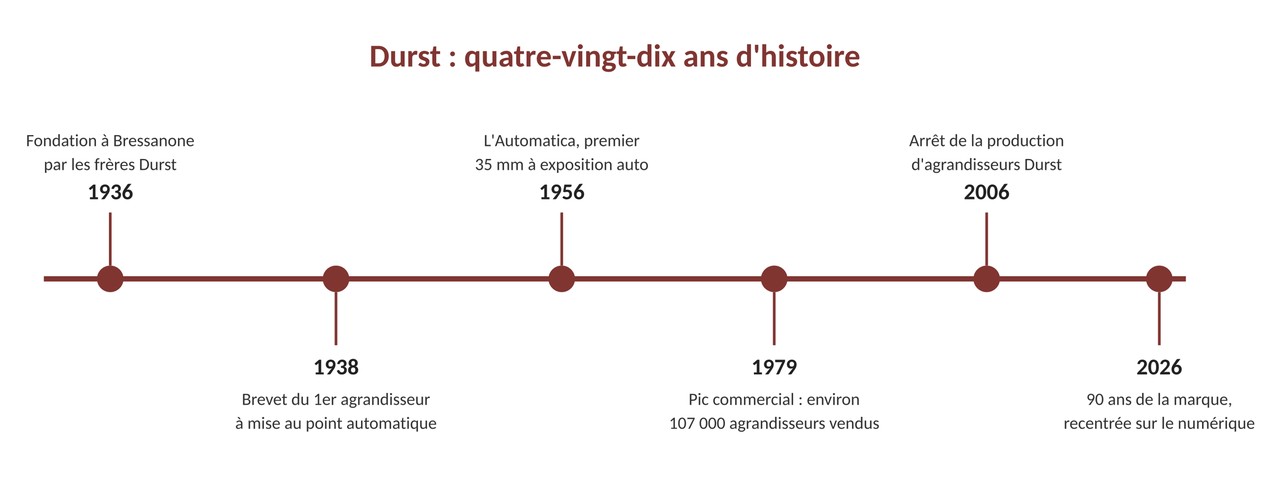
The story begins in 1936 in Bressanone, in South Tyrol, which had recently become Italian. Two brothers, Julius and Gilbert Durst, passionate about photography and encouraged by a mother who was herself a darkroom enthusiast, set up a camera repair business inside an old brewery. Funding came from a local family of leatherworkers, the Oberrauchs, who would remain linked to the company for decades.
Very soon the two brothers were no longer just repairing: they were inventing. In 1938 they patented an autofocus enlarger, an idea ahead of its time. Durst would also make cameras for almost twenty-five years, including the brand's first 6×9 medium format camera, the Gil, in 1938, then a 35mm automatic-exposure camera, the Automatica, in 1956. But the enlarger would become the company's true calling.
The company grew without major setbacks, avoiding arms production during the war thanks to its small size. It reached its commercial peak in 1979, with around 107,000 enlargers sold in that year alone. More than five hundred patents would be filed over time on enlarging mechanisms and lenses.
Its decline followed the same path as film as a whole: the rise of minilabs, then the arrival of digital, eventually got the better of this historic business. Durst stopped making enlargers at the end of 2006. Yet the company still exists today, reinvented as a maker of large-format digital printers (the Lambda, Rho and Tau ranges), and celebrates its ninetieth anniversary in 2026.
Key dates in the history of Durst, from its founding to its move into digital.
It was during the brand's boom years, between the mid-1970s and the early 1980s, that the M800 joined the Durst catalogue. It held a special place: an enlarger able to go up to 6×9 cm, when much of the brand's consumer range stopped at 35mm or 6×6.
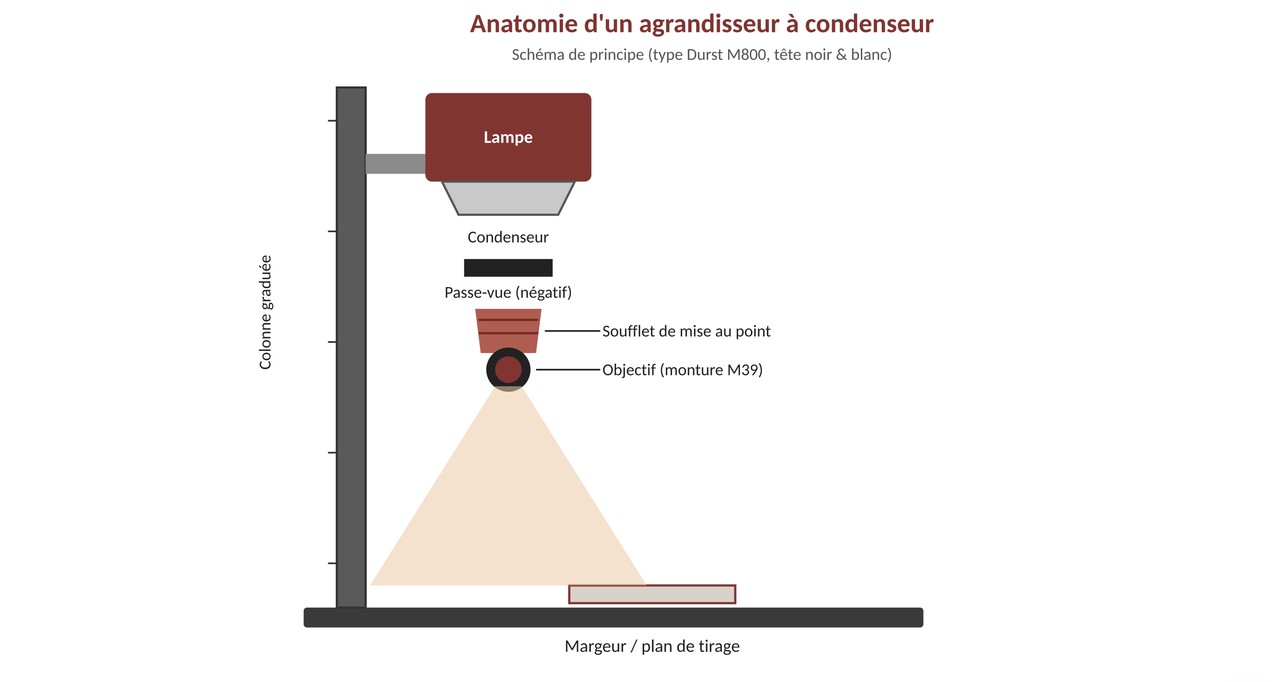
In use, the machine has a reputation for being indestructible: a mass of metal on a column, with a head that can tilt to correct architectural perspectives, a feature valued by building photographers. The basic version is monochrome, with a condenser, lit by a simple 220 V bulb in semi-diffused light. Variants exist with a colour head (a CLS 80 for example), this time working by diffusion, without a condenser, with cyan, magenta and yellow filtration.
The flip side of this versatility: each negative format needs its own condenser and negative carrier. Switching from 35mm to 6×9 on the same machine means owning the right parts, which are now rare and sometimes expensive second-hand. This is the main warning from users swapping advice online: better to buy a « complete » M800 than a bare chassis, or you may spend months hunting for the missing part.
Another detail that matters for anyone wanting to keep the machine running today: the lens board has an M39 thread, the so-called « Leica thread » standard, the most common among enlarger makers at the time. Even today, this choice opens the M800 up to almost every enlarging lens available second-hand.
Diagram of a condenser enlarger, like the M800's black and white head.
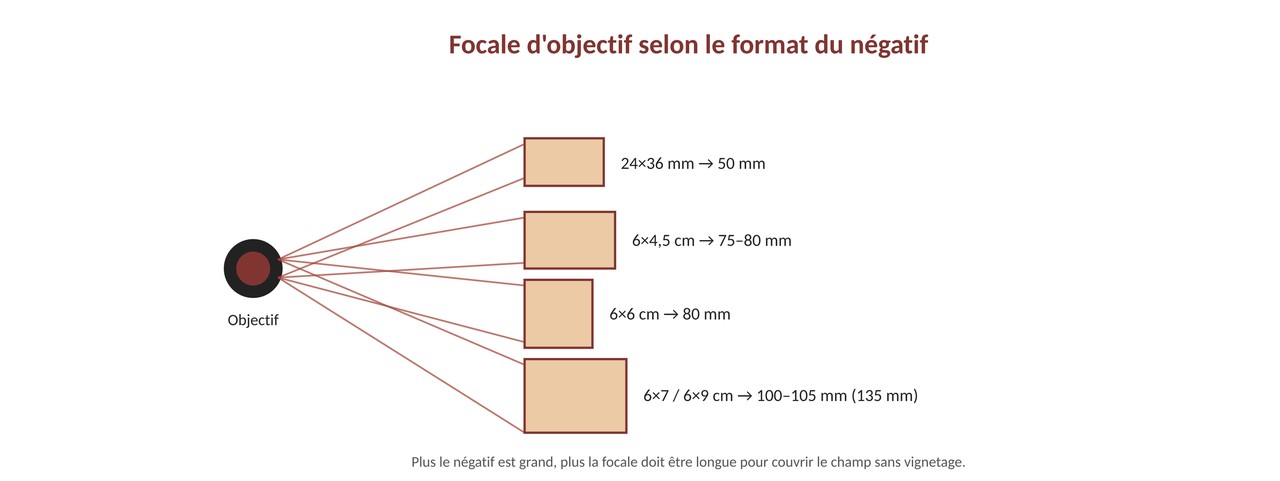
Before comparing lens brands, a reminder: the focal length must suit the format of the projected negative, or you risk vignetting or a loss of quality at the edges.
| Negative format | Recommended focal length |
|---|---|
24×36 mm | 50 mm |
6×4,5 cm | 75 to 80 mm |
6×6 cm | 80 mm |
6×7 / 6×9 cm | 100 to 105 mm (sometimes 135 mm) |
A detail little known to outsiders: Durst never made its own glass. The lenses sold under its name, the Neonon and Neotaron, actually came from the workshops of two German optics giants, Schneider-Kreuznach and Rodenstock, which also supplied the competition. Here, focal length by focal length, are the main lens families you can fit on an M800.
| Brand / Range | Actual maker | Common focal lengths | Design | Strengths | Points to watch |
|---|---|---|---|---|---|
Durst Neonon | Schneider-Kreuznach | 50, 80, 105 mm | 6 elements | Good value, very common second-hand, designed for Durst enlargers | A notch below Schneider's « pro » ranges; apertures sometimes gummed up |
Durst Neotaron | Rodenstock | 50 mm | 6 elements | Affordable Rodenstock alternative, good field uniformity | Narrower range than the Rodagon |
Schneider Componon | Schneider-Kreuznach | 50, 80, 100, 135 mm | 4 elements | Excellent classic, good centre sharpness | Slightly less even at the edges than the Componon-S |
Schneider Componon-S | Schneider-Kreuznach | 50, 80, 100, 135, 150 mm | 6 elements | Historic benchmark for B&W and colour, very flat field, high contrast | Higher second-hand price, slightly larger |
Rodenstock Rodagon | Rodenstock | 50, 80, 90, 105, 135, 150 mm | 6 elements | Very high resolution, excellent sharpness right to the edges | Price similar to the Componon-S, long focal lengths rarer |
Nikon EL-Nikkor | Nikon | 50, 63, 75, 80, 105, 135 mm | 4 to 6 elements depending on version | Very good reputation, excellent mechanical rigidity, easy to find | 4-element versions a notch below the Componon-S / Rodagon at the edges |
Fujinon EX / Fujinar | Fujifilm | 50, 75, 90, 105 mm | 6 elements (EX) | Very good optical level, often more affordable | Less common in Europe, manuals sometimes in Japanese |
Meopta Meogon / Anaret | Meopta | 50, 80 mm | 6 (Meogon) / 4 (Anaret) | Good value for money, native M39 mount | More limited range of focal lengths for medium format |
In practice, the Componon-S and Rodagon pair is the absolute benchmark, especially at the edges of the image. The in-house Neonon and Neotaron lenses, made in the same German factories, remain a sensible choice for equipping an M800 without breaking the bank. The EL-Nikkors, very common second-hand, usefully complete the picture for tight budgets.
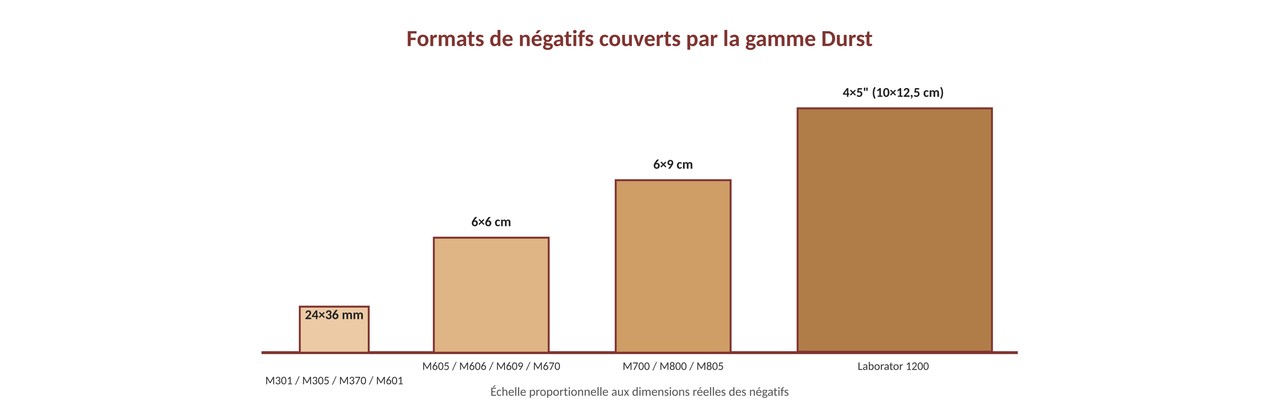
The M800 was just one piece of a sprawling Durst catalogue, from the entry-level plastic model to the professional studio machine. Here is how it compares with the brand's other film enlargers.
| Model | Max. format | Light source | Intended for | What sets them apart |
|---|---|---|---|---|
M301 / M305 | 24×36 mm | Condenser (B&W) or CLS colour head depending on version | Beginners, small budgets | Entry level, often plastic, 35mm only |
M370 | 24×36 mm | Condenser / colour head | Enthusiasts | More refined than the M305, sturdier chassis, still limited to 35mm |
M601 | 24×36 mm (extendable to 4.5×6 with accessories) | Semi-diffused condenser | Experienced enthusiasts | Known for sturdiness, graduated column, many accessories |
M605 / M606 / M609 | 6×6 cm | Condenser or variable-geometry light box | Medium format enthusiasts | Popular balance of compactness and versatility, much sought after second-hand |
M670 | 6×6 cm | « Vario-contrast » diffusion head | Enthusiasts and semi-pro B&W | Designed for multigrade paper, dedicated light boxes for each format |
M700 / M800 / M805 | 6×9 cm | Condenser (M700, M800) or CLS colour head (M805) | Demanding medium format photographers | The historic medium format trio; the M805 succeeded the M800, itself the heir to the M700 |
Laborator 1200 | 24×36 mm to 10×12.5 cm (4×5") | Condenser or CLS 450 / CLS 501 colour head | Studios and professionals | Top of the range, the only mainstream model to also cover 4×5" large format |
Three families clearly emerge. At the bottom, the M301, M305 and M370 target 35mm and occasional use, with lighter chassis. In the middle, the M605, M606, M609 and M670 are for enthusiasts who also want to print 6×6, with more elaborate lighting systems. At the top, the M700, M800 and M805 trio goes up to 6×9, before the Laborator 1200 alone opens the door to 4×5 inches for professionals using view cameras.
The M800 thus holds a pivotal position: more versatile than a simple 35mm enlarger, but far from the size and budget of a Laborator 1200. That probably explains its lasting popularity with medium format enthusiasts who have neither the space nor the wish to take on a studio machine.
Almost fifty years after its launch, the Durst M800 is still one of the most sought-after medium format enlargers second-hand: sturdy, able to go up to 6×9 cm, and compatible, thanks to its M39 mount, with almost all the major enlarging lenses on the market. Provided you find it complete, with accessories and condensers, it still offers an excellent way into film medium format, between the brand's small 35mm models and the imposing Laborator 1200 reserved for professional workshops.
Exhibitions, events, calls for projects and blog articles: get the key news from the Argia Collective straight to your inbox.
It is a medium format film enlarger made by the Italian brand Durst from the mid-1970s. It can enlarge negatives up to 6×9 cm.
From 24×36 mm up to 6×9 cm, provided you have the right condenser and negative carrier for each format.
Its lens board has an M39 thread (the so-called « Leica thread »), the most common on enlargers. So it accepts most enlarging lenses: Schneider Componon-S, Rodenstock Rodagon, Nikon EL-Nikkor, as well as the Neonon and Neotaron sold by Durst.
No. Durst stopped making enlargers at the end of 2006 and reinvented itself as a maker of large-format digital printers. The company celebrates its ninetieth anniversary in 2026.
Grain, chemistry, light: dive deeper into film photography.
Cookies
We and selected third parties use cookies or similar technologies for technical purposes and, with your consent, for experience, measurement and marketing.