Pierre Le Forestier
From Niépce's camera obscura to Doisneau's pavements, how a country fell in love with the image, and why it never got over it.
Two centuries ago, in a village in Burgundy, a man watched the world slowly imprint itself on a plate. What Nicéphore Niépce didn't yet know was that he had just opened the door to an adventure that would become, in France more than anywhere else, a true love story.
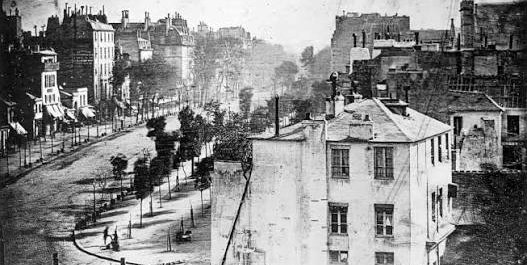
It all starts here: Niépce in Burgundy, then Daguerre in Paris, and the day the French state chose to give the invention « to the whole world ». We won't tell the story of that birth in detail here, it has its own pages: what exactly we are celebrating with the bicentenary of photography in 2027, and the story of 19 August, World Photography Day.
What interests us here is what came next. The enthusiasm was immediate and almost feverish: studios opening on the boulevards, portraits snapped up by the bourgeoisie, photographers travelling as far as Egypt to bring back views of temples. In 1854 the Société française de photographie was founded, one of the oldest institutions of its kind in the world: the country very quickly took its new art seriously.
Maxime Du Camp, colossus of the great temple of Abu Simbel, 1850. Public domain (Metropolitan Museum of Art).
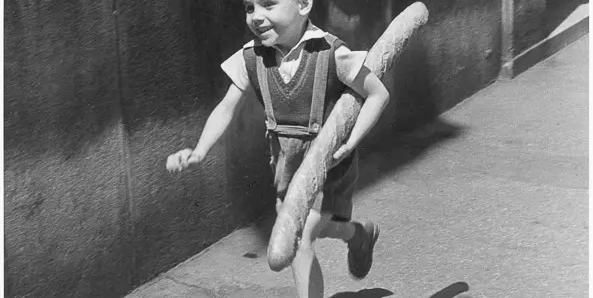
In the 20th century, French photography perhaps found its most distinctive voice. A generation of photographers took to the streets to capture ordinary people's lives, with no apparent staging: a stolen kiss, a child at play, a bistro coming to life early in the morning. Doisneau, Ronis, Boubat, Izis, Sabine Weiss... and, towering above this family, the tall figure of Henri Cartier-Bresson and his « decisive moment ». A movement that art history would name after the fact, and which we tell separately: What is humanist photography?
What remains is a way of seeing: in France, photography is seen less as a technical feat than as an art of looking and of encounter.
Willy Ronis, Montmartre, 1960. © Donation Willy Ronis, Ministère de la Culture (France), Médiathèque du patrimoine et de la photographie, distributed by GrandPalaisRmn Photo
This passion hasn't stayed in the history books. It has its events, its places, its audience.
French photography is this too: less a heritage than a shared practice.
The Musée Nicéphore Niépce, Chalon-sur-Saône.
This is where Argia comes in. Our photography collective, born in the Basque Country, exhibits, passes on and brings people together: two editions of Crossed Perspectives in 2026, and soon the Three Crowns Festival, whose first edition will take place in Hendaye in the week of 12 April 2027, right in the bicentenary year. One more way to keep this French passion alive, on the border and a little in our own way. Discover the birth of the Three Crowns Festival.
Crossed Perspectives, Hendaye, 2026. © Argia Collective
From the Rencontres d'Arles to the countless amateurs who, smartphone in pocket, unknowingly carry on the gesture Niépce began, the passion is intact. From the first faltering heliographs to digital sensors, photography in France remains what it has always been: a way of loving the world by looking at it.
Because the invention was born there, the state gave it to the world, and the country very early on built institutions (the Société française de photographie dates from 1854) and a tradition of looking based on encounters rather than technical prowess.
At the Musée Nicéphore Niépce in Chalon-sur-Saône, the town where the inventor made his first images.
To discover a wide range of photographers and their work, visit the website of the Médiathèque du patrimoine et de la photographie (MPP), part of the French Ministry of Culture: https://mediatheque-patrimoine.culture.gouv.fr/
Exhibitions, events, calls for projects and blog articles: get the key news from the Argia Collective straight to your inbox.
Cookies
We and selected third parties use cookies or similar technologies for technical purposes and, with your consent, for experience, measurement and marketing.