Pierre Le Forestier
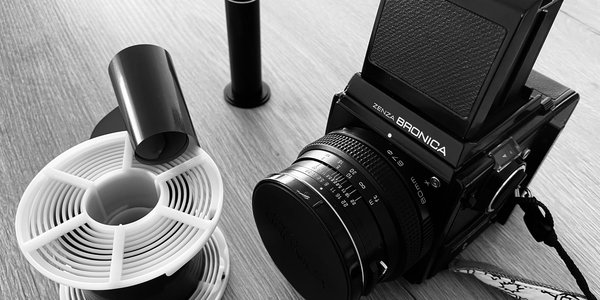
The Zenzanon PS lenses make up the lens range of the Bronica SQ system, one of the most affordable 6×6 medium format systems in film photography. From the 35mm fisheye to the 500mm catadioptric, this series covers every photographic use in 6×6: here is a reasoned catalogue, focal length by focal length.
System: Bronica SQ / SQ-A / SQ-Ai / SQ-B, 6×6 cm (56×56 mm)
Generation: PS series (1986-2004)
The Bronica SQ system was born in 1980 with the first generation of Zenzanon S lenses. Six years later, in 1986, the PS series completely renewed the range: optical designs recalculated on the basis of MTF curves, improved multi-coating, and the removal of the mechanical shutter-cocking transmission behind the famous « Sloppy Lens Syndrome » that affected some S-series lenses. Twelve focal lengths, two zooms and two teleconverters make up the full range. Each lens has a built-in Seiko leaf shutter, flash-synced at every speed up to 1/500th. It's one of the system's major strengths!
The « normal » focal length for 6×6 is 80mm, matching the diagonal of the negative (≈79 mm). Anything shorter is wide angle; anything longer gradually moves into portrait, telephoto and then super-telephoto territory. The PS range runs from 35mm to 500mm.
| Lens | 35mm equiv. | 6×6 angle | Min. dist. | Filter | Use | Availability |
|---|---|---|---|---|---|---|
35mm f/3.5 Fish-eye | ~22mm | 180° | 0.3 m | _ | Fisheye / creative | Rare |
40mm f/4 | ~23mm | 87° | 0.4 m | 95mm | Wide angle / architecture | Common |
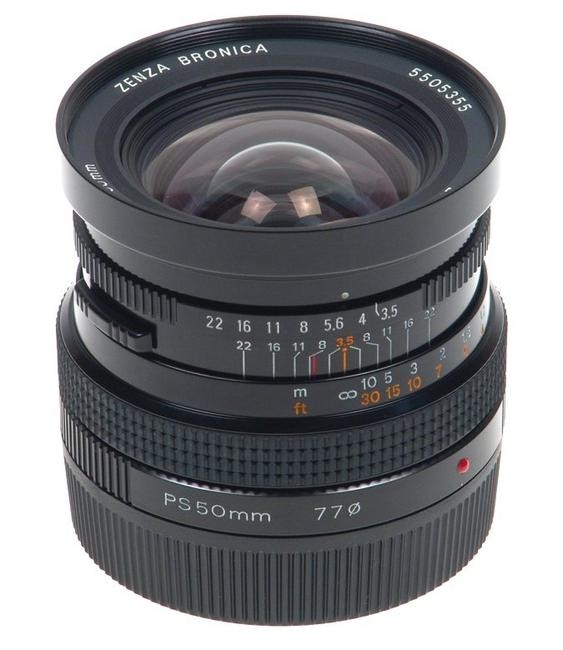
50mm f/3.5 | ~28mm | 76° | 0.5 m | 77mm | Wide angle / reportage | Common |
65mm f/4 | ~35mm | 62° | 0.6 m | 67mm | Semi wide angle | Common |
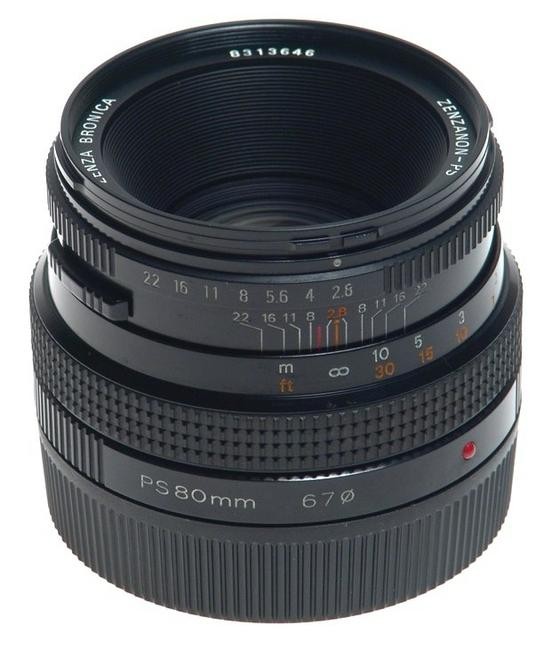
80mm f/2.8 | ~45mm | 51° | 0.8 m | 67mm | Standard / all-round | Common |
110mm f/4 Macro | ~60mm | 40° | 0.45 m | 72mm | Portrait / macro | Common |
135mm f/4 | ~76mm | 33° | 1.0 m | 67mm | Mid-length portrait | Rare |
150mm f/4 | ~85mm | 29° | 1.5 m | 67mm | Classic portrait | Common |
180mm f/4.5 | ~100mm | 25° | 1.0 m | 67mm | Portrait / fashion | Rare |
200mm f/4.5 | ~112mm | 22° | 1.8 m | 72mm | Light telephoto | Rare |
250mm f/5.6 | ~140mm | 18° | 2.0 m | 72mm | Telephoto | Common |
500mm f/8 | ~280mm | 9° | 4.0 m | _ | Catadioptric / nature | Rare |
Note: 35mm equivalents and angles of view are calculated for the 6×6 format (56×56 mm, diagonal ≈79 mm). The 50-100mm f/4-5.6 and 75-150mm f/4.5 zooms also exist in the PS series but are left out of this catalogue, which focuses on prime lenses.
Equiv. ~22mm; Angle 180°; Min. dist. 0.3 m; Rare
The only fisheye in the PS range, and a lens in a class of its own in this catalogue. With its 180° angle, it produces a circular image that doesn't fill the square 6×6 frame: a circle of image in the centre, surrounded by black corners. The effect is radical and deliberately non-naturalistic. No filter thread: filters fit at the back of the lens. Minimum distance 30 cm.
Verdict: The ultimate niche lens. Essential if the fisheye look is part of your visual vocabulary; unnecessary in every other case. Hard to find: keep an eye on Japanese markets.
Equiv. ~23mm; Angle 87°; Min. dist. 0.4 m; Filter 95mm; Common
The 40mm is the widest rectilinear lens available for the SQ system. At ~23mm in 35mm terms, it offers a very wide angle of view: ideal for interiors, architecture, landscapes and large groups. Its remarkable depth of field even wide open makes it a very flexible tool in the field. Its only practical drawback: the 95mm filter thread, the largest in the whole range, which makes filters bulky and expensive.
Verdict: The tool of architects and landscape photographers. It demands discipline in composition, as perspective distortion is strong. Well represented on the second-hand market at a reasonable price.
Equiv. ~28mm; Angle 76°; Min. dist. 0.4 m; Filter 77mm; Common
The 50mm PS is regarded as the system's standard wide angle, comparable to a 28mm in 35mm. Its rectilinear design corrects distortion, making it a very versatile lens, especially for photojournalism, some portraits and landscapes. Users say its colour rendering is excellent in saturation and contrast. Its only practical annoyance is the 77mm filter thread, which can't be shared with the 67mm of the rest of the range, so you have to carry an extra set of filters or a step ring.
Verdict: Together with the 80mm and the 150mm, it is one of the three most used lenses in the system. A must for reportage and landscape. Widely available and affordable.
Equiv. ~35mm; Angle 62°; Min. dist. 0.6 m; Filter 67mm; Common
The 65mm holds a strategic place in the range: at ~35mm in 35mm terms, it gives a slightly wider perspective than the human eye without a pronounced wide-angle effect. Wedding photographers used it for years for group portraits, architectural shots and reception scenes: a focal length that covers a wide variety of situations without ever betraying reality. Its 67mm filter thread makes it compatible with the filters of the 80mm, 110mm, 135mm, 150mm and 180mm: one of the few wide angles to share this standard with the portrait lenses.
« An almost universal focal length for weddings and reportage in 6×6: wide enough for interiors, tight enough for group portraits. » Camera Review Blog, Bronica SQ-Ai
Verdict: The most underrated focal length in the range. Ideal for anyone who wants a single lens covering architecture, landscape and group portraits. The choice of a generation of professional wedding photographers.
Equiv. ~45mm; Angle 51°; Min. dist. 0.8 m; Filter 67mm; Max. ap. f/2.8; Very common
The 80mm f/2.8 PS is the kit lens supplied with the SQ-A, SQ-Ai and SQ-B bodies. It is the « normal » focal length for 6×6, matching the diagonal of the negative and giving a perspective close to human vision. It is also the fastest lens in the range, making it the first choice in low light. Its resolution and edge-to-edge sharpness are remarkable; it is used for weddings, portraits, architecture and commercial photography alike. Some users nevertheless feel the 150mm PS outperforms it in sharpness, a recurring observation on specialist forums.
Verdict: The starting point of any SQ system. The lens you discover the format with, before building your collection. Widely available and very affordable; kit copies are often in excellent condition.
Equiv. ~60mm; Angle 40°; Min. dist. 0.45 m; Filter 72mm; Macro 1:4
Designed as a macro (1:4 ratio at 45 cm), but extremely effective for close-up portraits. At about 60mm in 35mm terms, its perspective is natural without being standard. The very short minimum distance makes up for the lack of strong compression: you can frame very tightly without stepping back. The only drawback in the portrait range: the 72mm filter thread, which can't be shared with the 67mm of the other portrait lenses.
Verdict: The small studio's tool. First choice for anyone short of space who wants a versatile lens for everything from portraits to still life.
Note: there is a newer and more expensive f/4.5 version with a 1:1 ratio, making it the only lens of its kind available in 6×6 format, across all brands.
Equiv. ~76mm; Angle 33°; Min. dist. 1.0 m; Filter 67mm; Rare
The 135mm is never the first portrait lens people mention for the SQ system, which is unfair. At ~76mm in 35mm terms, it sits exactly in « universal portrait » territory: long enough to slightly flatten features, short enough to work at a comfortable distance, with a one-metre minimum distance. Rarely made and little documented, it is hard to find second-hand.
Verdict: Grab it if one comes up at a good price. Hard to justify against the more available 150mm, but valuable for anyone looking for exactly this perspective.
Equiv. ~85mm; Angle 29°; Min. dist. 1.5 m; Filter 67mm; Very common
Thousands of professional portraits were made with this 150mm in the 1980s and 1990s. Flattering compression at ~85mm equivalent, pleasant bokeh, 1/500th flash sync for outdoor fill-in. Several photographers find it sharper than the 80mm kit lens, which says a lot about the quality of the PS optical formula. Its only limitation is practical: the 1.5 m minimum distance means stepping back for very tight portraits, which can be restrictive in a small studio.
Verdict: A choice you won't regret. Affordable, available, extremely effective. The first purchase after the 80mm kit lens for any photographer interested in portraiture.
Equiv. ~100mm; Angle 25°; Min. dist. 1.0 m; Filter 67mm; Rare
« Considered by many to be the best portrait lens in the whole Zenzanon PS range. » Photrio forum, Bronica SQ users
The 180mm's paradox: a longer focal length than the 150mm, but a shorter minimum distance (1 m versus 1.5 m). Maximum compression and closeness to the subject: a rare combination. Its f/4.5 aperture (a third of a stop slower than the 150mm) is its only concession. A modern optical design with excellent contrast and resolution wide open.
Verdict: The ultimate portrait lens of the SQ system. Worth actively seeking out; copies from Japan are often in good condition.
Equiv. ~112mm; Angle 22°; Min. dist. 1.8 m; Filter 72mm; Rare
The 200mm f/4.5 PS logically extends the portrait range towards even stronger compression. At ~112mm in 35mm terms, it enters the territory of very tight portraits and small-scale sport. Less sought after than the 180mm, whose shorter minimum distance is often preferred, it remains an interesting option for medium-distance wildlife or indoor sport. Fairly rare on the second-hand market.
Verdict: A niche between the 180mm and the 250mm. Relevant for wildlife, light sport or very long-distance portraits. Worth watching for at a good price.
Equiv. ~140mm; Angle 18°; Min. dist. 2.0 m; Filter 72mm; Common
The 250mm f/5.6 is one of the most used long lenses in the SQ system: several photographers list it among their three core lenses, alongside the 50mm and 80mm. At ~140mm equivalent, it opens up sport, wildlife and compressed landscapes. Its availability and reasonable price make it the natural way into telephoto work on the SQ. Paired with the 2x teleconverter, it approaches 500mm: a far cheaper alternative to buying the original 500mm, at the cost of a noticeable loss of sharpness.
Verdict: The system's benchmark telephoto. Well represented second-hand, solid optical quality, versatile from sport to wildlife.
Equiv. ~280mm; Angle 9°; Min. dist. 4.0 m; Very rare
The 500mm f/8 PS is a catadioptric lens: a « mirror » design that folds the light path to get a long focal length in a compact barrel. Advantage: smaller size and moderate weight. Drawbacks inherent to this design: a fixed aperture (you can't stop down, so no control of depth of field through aperture), and characteristic ring-shaped bokeh on out-of-focus highlights, a look people either love or hate. Filters fit at the back of the lens. Very rare second-hand.
Verdict: A specialist lens for distant wildlife and terrestrial astronomy. The ring bokeh is a stylistic signature, not a flaw for those who embrace it. Budget alternative: the 250mm + 2x teleconverter.
The PS range covers every photographic use in 6×6. In practice, no photographer uses all twelve focal lengths. Some combinations stand out depending on your profile:
| Profile | Recommended combination | Rationale |
|---|---|---|
Street / reportage photographer | 50mm + 80mm | Wide angle + standard, light, discreet |
Weddings / events | 65mm + 80mm + 150mm | Covers everything from groups to tight portraits |
Small studio portraits | 110mm + 150mm | Close-up macro + classic portrait |
Fashion / beauty portraits | 150mm + 180mm | Standard portrait + maximum compression |
Nature / wildlife | 250mm (+ 2x conv.) | Reach + compression, value for money |
Complete all-round system | 50 + 80 + 150 + 250mm | The most common and coherent combination |
We share this expertise in film medium format within the collective. Discover the film work of Simon Arcache at Crossed Perspectives #1, Sound and Vision (31 July - 2 August, Hendaye, free entry), and our companion article on the Pentax 645 system.
Exhibitions, events, calls for projects and blog articles: get the key news from the Argia Collective straight to your inbox.
Grain, chemistry, light: dive deeper into film photography.
Cookies
We and selected third parties use cookies or similar technologies for technical purposes and, with your consent, for experience, measurement and marketing.